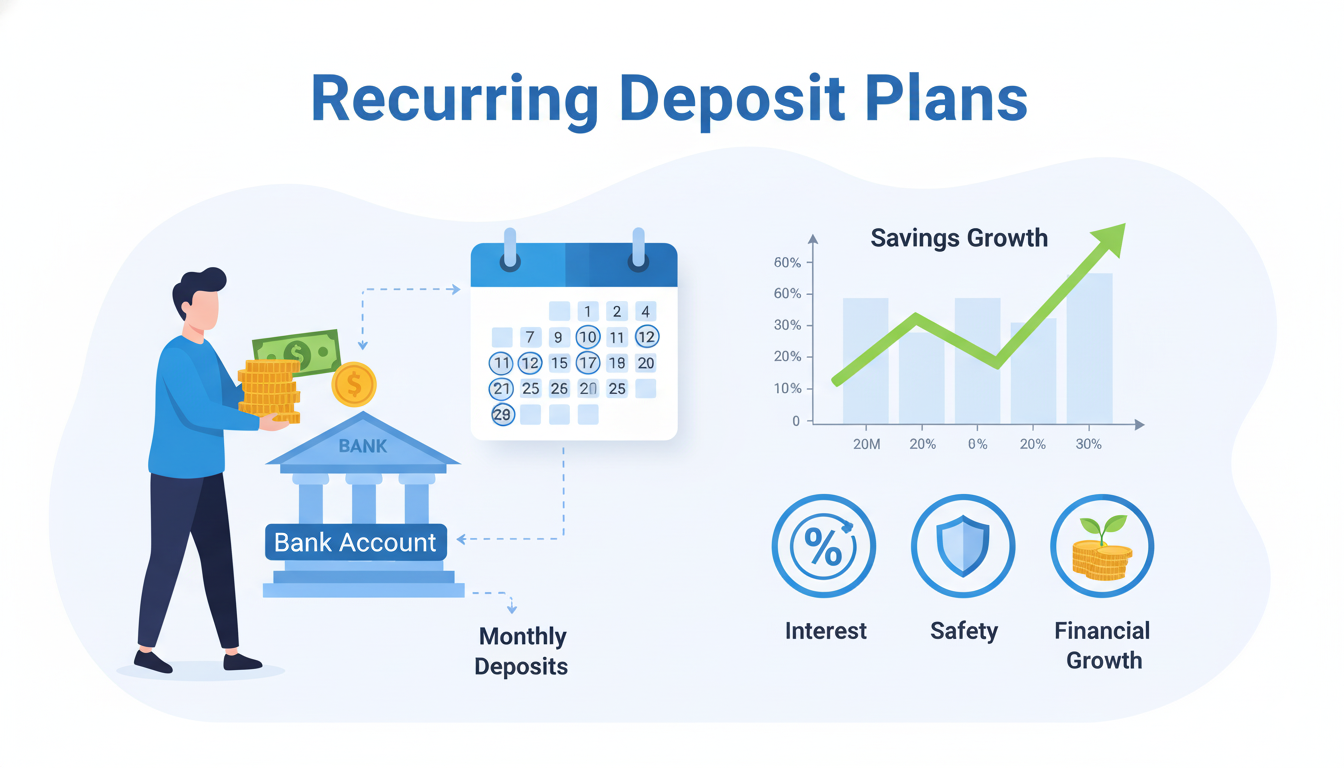
In today’s fast-paced world, managing finances efficiently is more important than ever. One of the most reliable ways to save money and earn guaranteed returns is through recurring deposit plans. These plans are offered by banks and financial institutions and are designed for individuals who want to save a fixed amount regularly while earning interest over time. In this blog, we will explore everything you need to know about recurring deposit plans, including their benefits, types, eligibility, interest rates, and tips to maximize returns.
What Are Recurring Deposit Plans?
A recurring deposit plan (RD) is a financial product where an individual deposits a fixed sum of money into their account at regular intervals, usually monthly, for a predetermined period. Unlike a fixed deposit, where you invest a lump sum at once, a recurring deposit allows you to save gradually. The bank pays interest on the accumulated amount at the end of the tenure, making it an ideal savings tool for disciplined investors.
For instance, if you deposit ₹5,000 every month for one year, the bank calculates interest on your monthly deposits and pays the total maturity amount at the end of 12 months. This systematic saving approach helps inculcate financial discipline and builds a sizeable corpus over time.
Key Features of Recurring Deposit Plans
Understanding the key features of recurring deposit plans will help you decide whether this investment suits your financial goals:
-
Fixed Monthly Contributions: You deposit a predetermined sum every month. The amount can be small or large, depending on your savings capacity.
-
Flexible Tenure: RD plans usually come with a tenure ranging from 6 months to 10 years. You can choose a duration based on your financial goal.
-
Guaranteed Returns: Since RD interest rates are fixed, you know exactly how much you will earn at maturity.
-
Interest Compounding: Banks calculate interest on a quarterly or annual basis, which increases your total returns.
-
Premature Withdrawal Option: While the ideal is to complete the RD term, most banks allow premature withdrawals with a small penalty.
-
Loan Facility: Many banks offer loans against recurring deposit plans, providing liquidity without breaking the deposit.
Types of Recurring Deposit Plans
Recurring deposit plans are not one-size-fits-all. Depending on your needs, banks provide several types:

1. Standard Recurring Deposit
This is the most common type, where you deposit a fixed amount every month for a fixed period. Interest rates vary slightly between banks but are generally in the range of 5% to 7% annually.
2. Flexi Recurring Deposit
Flexi RDs allow you to deposit variable amounts each month. This is suitable for individuals whose income is irregular or fluctuates monthly.
3. Senior Citizen Recurring Deposit
Designed specifically for senior citizens, these plans offer higher interest rates than regular RDs, often 0.5% to 1% more.
4. Tax-Saving Recurring Deposit
These plans come with a lock-in period of 5 years and qualify for tax benefits under Section 80C of the Income Tax Act. They are ideal for individuals seeking both savings and tax planning.
5. Recurring Deposit with Cumulative Interest
In this type, interest is compounded periodically and paid along with the principal at maturity, maximizing returns over time.
Benefits of Recurring Deposit Plans
Recurring deposit plans offer multiple advantages that make them an attractive option for conservative investors:
1. Disciplined Savings
By depositing a fixed amount every month, you develop a habit of saving regularly, which is crucial for financial stability.
2. Guaranteed Returns
Unlike the stock market or mutual funds, RD plans provide fixed returns, making them a safe investment option.
3. Flexible Tenure and Deposit Amount
You can choose a deposit amount and tenure according to your financial goals, whether short-term or long-term.
4. Loan Facility
Many banks offer loans against recurring deposits, giving you easy access to funds in emergencies.

5. Tax Benefits
Certain recurring deposit plans, like tax-saving RDs, provide exemptions under Section 80C, reducing your taxable income.
6. No Market Risk
RD plans are unaffected by market volatility, ensuring your principal and interest remain safe.
7. Easy to Open and Manage
Opening an RD account is straightforward. Many banks allow you to set up automatic monthly deductions from your savings account.
How to Calculate Returns on Recurring Deposit Plans
Calculating returns on recurring deposit plans is simpler than it seems. Banks use a compound interest formula, typically compounded quarterly. Here’s a simplified approach:
Formula:
Maturity Amount (A) = P × n + Interest
Where:
-
P = Monthly deposit
-
n = Number of months
-
Interest = Calculated using the bank’s interest rate

For precise calculations, most banks provide online RD calculators. Simply input your monthly deposit, tenure, and interest rate to know your maturity amount.
Eligibility Criteria for Recurring Deposit Plans
Most banks have simple eligibility criteria for recurring deposit plans:
-
Must be an Indian resident (resident or non-resident Indian for some banks)
-
Age should be 18 years or above (minors require a guardian)
-
PAN card and KYC documents for identity verification
-
Minimum monthly deposit requirement as per the bank
Documents Required to Open a Recurring Deposit Account
To open an RD account, you typically need the following documents:
-
Proof of Identity: PAN card, Aadhaar, Passport, or Voter ID
-
Proof of Address: Aadhaar, Passport, Utility Bills, or Bank Statement
-
Passport-size Photograph

-
Bank Account Details for monthly deductions
Interest Rates on Recurring Deposit Plans
Interest rates for recurring deposit plans vary depending on the bank and tenure:
-
Public Sector Banks: 5% – 7% per annum
-
Private Banks: 6% – 7.5% per annum
-
Senior Citizens: Additional 0.25% – 1% on the standard rates
It’s advisable to compare rates across banks to maximize returns.
Tax Implications on Recurring Deposit Plans
Interest earned on recurring deposit plans is taxable under the head “Income from Other Sources.” Banks deduct Tax Deducted at Source (TDS) if the interest exceeds ₹40,000 per year (₹50,000 for senior citizens).
Tips to minimize tax impact:
-
Submit Form 15G/15H if your income is below the taxable limit
-
Consider tax-saving recurring deposits to reduce taxable income

Tips to Maximize Returns on Recurring Deposit Plans
-
Start Early: The earlier you start, the more you benefit from compounding.
-
Choose Longer Tenures: Longer RD tenures generally offer higher interest rates.
-
Invest Regularly: Avoid missing monthly deposits to ensure steady growth.
-
Compare Interest Rates: Different banks offer varying rates; select the best.
-
Consider Senior Citizen RD: If eligible, opt for higher interest rates.
Frequently Asked Questions (FAQs)
1. Can I break my recurring deposit before maturity?
Yes, most banks allow premature withdrawal but may levy a small penalty.
2. Is interest on recurring deposits compounded?
Yes, banks generally compound interest quarterly, enhancing your returns.
3. Can a minor open a recurring deposit account?
Yes, with a guardian managing the account until the minor reaches adulthood.
4. Are recurring deposits safe?
Absolutely. RDs are considered low-risk as they are not affected by market fluctuations.
5. How does RD differ from a fixed deposit?
In an RD, you deposit a fixed sum monthly, whereas a fixed deposit requires a lump sum investment at the beginning.
6. Can I take a loan against my RD?
Yes, most banks provide loans up to 90% of the RD amount without breaking the deposit.
Conclusion
Recurring deposit plans are a perfect blend of safety, discipline, and growth. They encourage regular savings, provide guaranteed returns, and offer flexibility in tenure and deposit amount. Whether you are a student, professional, or senior citizen, RDs can be tailored to suit your financial needs. By understanding the features, benefits, and tax implications of recurring deposit plans, you can make an informed decision to secure your financial future.
Start small, save consistently, and watch your savings grow steadily. With the power of compounding and disciplined investment, recurring deposit plans can be your pathway to financial stability and peace of mind.